Manhattan
Fake Dating Mr. CEO: A Billionaire, Enemies to Lovers RomanceManhattan is the novel’s principal urban setting and connective tissue. It gathers Bianca’s exhausting commute, Pierce Publishing’s polished but pressurized headquarters, the emerging rivalry with Emperor Penguin Publishing, and the city’s more intimate spaces—from a chocolate shop and Green-Wood Cemetery to a secluded room at a gala. Its decisive significance lies in the way movement through Manhattan repeatedly changes the stakes: a late-night summons turns the city into an ordeal, a new neighbor becomes a corporate threat, and spaces that seem public or private alternately conceal and expose relationships.
Urban Setting and Movement
Manhattan first appears as a city experienced from below rather than from a position of privilege. When Mr. Pierce summons Bianca back to the office by an all-capital emergency message, she leaves the comfort of her apartment and catches a train toward Midtown Manhattan. The journey makes her economic frustration tangible: she regrets not following her parents’ advice to practice law, compares herself with her younger brother Derek, who works at a top New York firm and earns five times her salary, and travels among bums and drunk teenagers while guarding her purse against a pickpocket’s familiar tactics. Her ten-minute walk from the station to the company building is shortened only by the speed of her anxious pace.
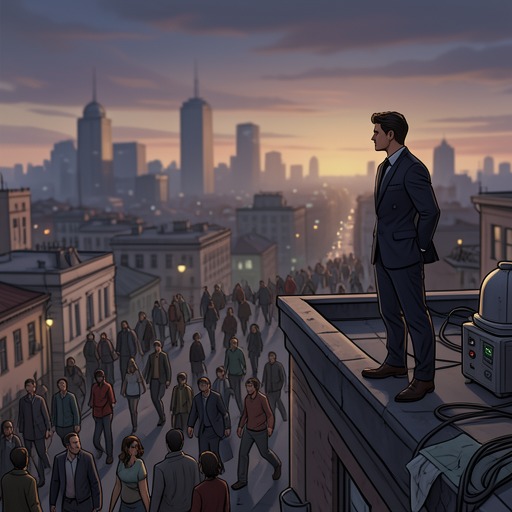
The city’s scale also frames the workplace’s peculiar prominence. The six-story building housing Pierce Publishing is dwarfed by Manhattan’s impressive skyline, yet its futuristic design allows it to stand out among neighboring structures. The contrast gives the publishing company a compact but potent presence: it lacks height, but not identity or authority. The building is not merely a backdrop for employment; it is the destination that repeatedly claims Bianca’s time, including after hours, and the institutional space from which the novel’s professional conflicts radiate.
Manhattan is also organized through everyday routes and small acts of self-maintenance. Bianca leaves the office for Nora’s Kitchen, a few buildings away, because the office has become monotonous and she wants to stretch and speak with someone outside work. She runs the roughly thirty-minute distance instead of exercising at the gym, then orders a grilled chicken Caesar salad with romaine lettuce, Parmesan shavings, tangy dressing, and iced green tea. Even this ordinary lunch becomes a form of reconnaissance when she overhears discussion of a new publishing company in the neighborhood and joins the conversation to obtain information.
Valentine’s Day and the City’s Romantic Surface
On Valentine’s Day, Manhattan displays a public romance that intensifies Bianca’s sense of isolation. The streets are crowded with lovers exchanging gifts and kissing openly, while Kenny’s Diner across the street is filled with couples dining or waiting for tables. Bianca tells others that she does not understand the fuss surrounding the holiday, but the scene exposes the desire beneath that pose: she imagines herself waiting outside a restaurant with a man if she had one. The city turns singledom into a spectacle because every street and restaurant seems arranged around couples.
That same urban landscape later becomes a setting for unexpected intimacy. Aiden takes Bianca to a quaint gift shop a few houses from their route, where they choose random chocolate flavors for one another. He then leads her to Green-Wood Cemetery, a place she considers so far from the expected luxury of his favorite New York destination that she feels overdressed there. Manhattan therefore complicates the assumptions attached to Aiden’s wealth and status. The city’s romantic possibility is not confined to restaurants or fashionable venues; it can extend into a cemetery, where the ordinary codes of courtship give way to quiet and strangeness.
The cemetery also functions as a counter-space to the city’s noisy commercial and romantic surfaces. Bianca expects pretension, but Aiden directs her toward a place defined by stillness rather than display. That choice makes Manhattan a landscape of tonal reversals: crowded streets produce loneliness, while an unconventional and solemn location creates room for attention. The city’s meaning changes according to who is looking and what the characters are prepared to recognize in it.
Corporate Territory and Publishing Rivalry
Manhattan becomes an arena of direct corporate conflict when a new publishing firm opens across from Pierce Publishing. Bianca notices the company while returning from lunch, then hides behind a pillar to verify the information. After Mia leaves in her car, Bianca asks the concierge about the businesses in the building and receives confirmation that Mia owns Emperor Penguin Publishing and has only recently established the office there. The physical proximity is crucial. The rival is not distant or abstract; Mia is positioned directly across the avenue, turning Manhattan’s architecture into a declaration of commercial war.
Bianca brings the discovery back to Aiden’s office, closes and locks the door, and tells him that Mia is their new neighbor. Bianca initially has to explain why the fact matters, but Aiden immediately understands once he hears that Mia is in town. The threat soon becomes measurable through the city’s business network: clients email to ask about the rival firm, and one message reports that another company is offering an extravagant signing bonus to attract authors while presenting itself as “legit and ethical.” Manhattan’s publishing district is thus rendered as a field of competing access, reputation, and inducement, where information travels rapidly from neighboring offices to authors and clients.
The city’s commercial geography also creates opportunities for Aiden’s counterstrategy. At a meeting with Leah Roberts, he proposes sending 15 percent of the profits to a charity of her choice and frames literacy as a basic necessity rather than a privilege. He then recognizes that Leah is considering an offer from Emperor Penguin and prepares to expose a problem beyond an ordinary competitive flaw. Manhattan supplies the proximity that makes rivalry immediate, but the conflict is fought through proposals, signing bonuses, ethical claims, and control over authors rather than through physical confrontation.
Enclosed Spaces and Public Exposure
Although Manhattan is open and mobile, many of its decisive scenes occur in enclosed rooms. The publishing building’s offices regulate access and privacy: Bianca locks Aiden’s office before disclosing the rival’s identity, while Aiden later escapes with Bianca after a first dance into an empty room in a secluded corner of a marquee. He locks the door behind them, temporarily converting a public celebration into a private enclosure. The movement from the dance floor to the closed room marks a change in the relationship’s value: social performance gives way to concealed intimacy.
The city’s interiors also hold institutional judgment. Pierce Publishing’s offices become the place where Aiden confronts the failure to detect seven plagiarized books. He demands an explanation from the editing staff and learns that searches had been limited to novels published in America and in English. The Manhattan office therefore embodies both the prestige of the publishing industry and the blind spots produced by its procedures. It is a workplace capable of international reach but trapped by narrow local assumptions, a contradiction that allows Bengali books to be translated and presented as English-language originals.
Manhattan’s enclosed spaces never remain wholly private for long. Emails cross offices, competitors appear across the street, and corporate decisions reverberate through the surrounding network. The novel repeatedly uses doors, pillars, elevators, desks, and locked rooms to stage the tension between concealment and revelation. A private conversation can expose a corporate threat; a secluded romantic encounter can become part of a larger emotional crisis; an office designed to control information can reveal how badly the institution has failed to control it.
From Private City to Public Threshold
The later airport scene extends Manhattan’s logic of movement and exposure beyond the ordinary office district. Bianca arrives with a suitcase and tries to leave, while Aiden uses the airport intercom to plead with her not to go without speaking to him. Guest Services becomes the point toward which the crowd’s attention converges. Bianca grips the suitcase handle, searches for the location, and finally chooses to meet him; the airport erupts as people point at her and discuss the woman Aiden Pierce is publicly begging to stay.
This moment completes Manhattan’s pattern of turning personal decisions into visible urban events. Bianca’s earlier movements through the city are driven by obligation, fear, curiosity, or desire: she hurries to work, investigates Mia’s office, visits a restaurant, follows Aiden to an unexpected destination, and enters a hidden room. At the airport, movement becomes a conscious choice rather than a reaction to someone else’s demand. Her decision to walk toward Aiden does not erase her doubts, but it changes departure into confrontation and private uncertainty into a public threshold.
Across the novel, Manhattan is therefore less a single picturesque location than a system of pressures and crossings. Its trains and avenues expose class anxiety; its buildings materialize corporate rivalry; its restaurants and cemetery reshape romantic expectation; its offices organize secrecy; and its airport transforms reconciliation into spectacle. The city continually asks whether a character is merely passing through or is willing to stop, enter, investigate, answer, and be seen.